


The Silver Lining of The Golden Globes
- Miles Stephenson

- Jan 18
- 6 min read
The unfortunate state of Hollywood movies, Stellan Skarsgård's promising win for Sentimental Value, Helen Mirren's well-deserved lifetime achievement award, and the hope of a comeback for cinema...
A friend asked me this week what I thought of the Golden Globes. After all, they hear me talk about movies all the time, so certainly I’d have an urgent take on one of cinema’s biggest awards ceremonies. I surprised them (and maybe myself) when I said I hadn’t tuned in.

Like many movie lovers, I’ve come to the regrettable conclusion that the criteria for selection used by our biggest award shows have become divorced from the art, workmanship, and taste of great filmmaking. Pageantry has always been part of Hollywood. Its shallowness and polish are as much a product of show business’ commercial sensibility as are the important films we’ve loved over the years. But as Hollywood continues its downward slope — afflicted by the forces of streaming, franchise reboots, and relegation by the short-form videos of the “second screen” — these award shows become less culturally significant and creatively charged. What is left is the superficiality of walk-and-talk red carpet gossip.
It’s with all this in mind that I regrettably streamed this year’s Golden Globes after the fact. While watching, I posted a poll to social media to get a sense of what my followers enjoyed about the award show (here I was a hypocrite distracted by my own “second screen!”) Of my followers, 64% said they hadn't watched the Golden Globes this year while only 36% had. This was no surprise: Golden Globes viewership has been on the decline for many years since its peak in the late 90s and early 2000s.

Of the last three years, there’s been a downward trajectory. In 2024, 9.4 million viewers tuned in. In 2025 that fell to 9.2 million. This year, 2026, it fell again to 8.6 million. Compare these numbers with the Golden Globes viewership of 2004 at 26.8 million viewers and you begin to see the shrinking of not just an award show, but an entire industry.
The next part of my poll asked my followers “of those who watched, which award recipient are you happiest about?” A majority of people (29%) were happiest about one award: Hamnet winning Best Drama. Stellan Skarsgård’s win as Best Supporting Actor for Sentimental Value got 22% of the vote, neck and neck with Timothée Chalamet’s win for Best Comedy or Musical Actor for Marty Supreme.
I was happy about Skarsgård’s win. I’ve been a fan of the Swedish actor since I first saw him in 1998’s Ronin where he played a calculating KGB-associated intelligence agent with a knack for double-crossing his peers. I saw Sentimental Value, the film for which he won the Golden Globe, in theaters in Sag Harbor and was struck by Skarsgård’s performance as a celebrated filmmaker but lackluster father to two young women in Oslo. As a father himself, Skarsgård said he felt empathy for this protagonist and understood the theme of the character to be “the conflict between your heart and your private life.” He remarked that it interested him that this character was “very sensible and soft” when it came to his art and yet had this complication and coldness with his family.

I was further excited about the project because the director, Joachim Trier, had made one of my favorite movies of the decade with The Worst Person in the World (2020), a dark rom-com and coming-of-age story about a young woman searching for meaning while suffering from her impulsivity. This film and his latest release, Sentimental Value, fill an important niche which Hollywood has largely forgotten: the mid-budget character drama. This type of story, about a handful of characters working through their fraught relationships, used to be the bread-and-butter of Burbank studios until the loss of DVD sales and the rise of streaming forced the mid-budget film offstage and exalted the big budget blockbuster as the mainstay of movies. With Sentimental Value, director Joachim Trier and actor Stellan Skarsgård are bringing back a smaller, more intimate story about family and the wounds we often inflict on one another while pursuing our own senses of fulfillment.

Any cinephile worth their salt knows Joachim’s cousin, Lars Von Trier, revolutionized moviemaking in the 1990s when he co-authored the “Dogme 95 Manifesto” which reoriented Scandinavian filmmaking (and later Hollywood) away from commercial action movies and towards the intimate, small budget relationship films for which the movement’s name has become synonymous.
While I watched Skarsgård receive his award at the Golden Globes, I was struck to see these dynamics come first circle in his speech. He talked about how theatergoing has almost disappeared. “In a cinema, when the lights go down, and eventually you share the pulse with some other people, that’s magic. Cinema should be seen in cinemas.”
Skarsgård, with the benefit of age and wisdom, sees a change in the industry that many seem to miss. He’s a very talented actor and a champion of the kinds of films that I believe are important to Hollywood’s survival and potential resurgence in the future. Despite all my reservations about these kinds of award shows, Skarsgård’s win gave me a twinge of hope.
The second award which delighted me went to Helen Mirren: a kind of lifetime achievement recognition in the Cecil B. DeMille Award. Mirren has been one of my favorite actresses probably since I saw her in Peter Greenaway’s 1989 film The Cook, The Thief, His Wife, & Her Lover. Like a rococo bottle episode, the whole movie takes place in only a handful of spaces. Set design fluctuates between a blood-red feast for the eyes, a sanitized space that verges on otherworldliness in a bleach-white bathroom, and storybook nooks like the pheasant larder and book depository, each possessed of a theatrical quality that makes the experience more like a Gaultier-costumed opera than a film.


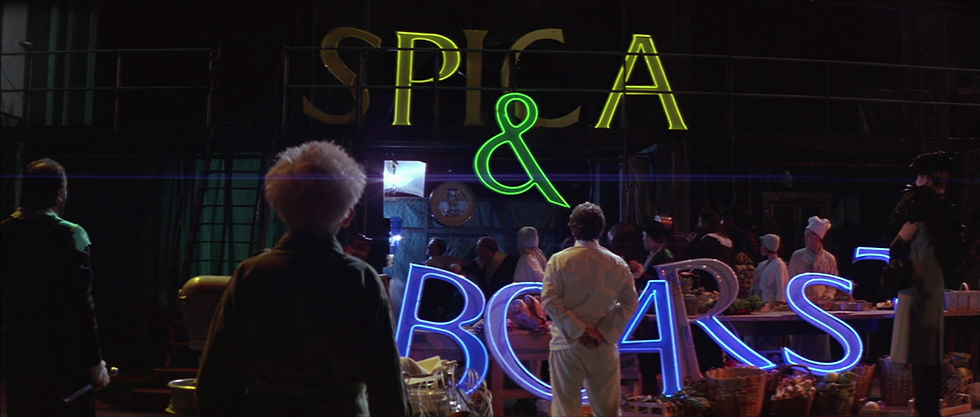

Here Mirren plays Georgina Spica, the eponymous wife of a brutal English gangster and restaurateur. Mirren falls in love with a quiet bookshop owner and tries to leave her violent husband for this kind man before disaster strikes. The scene where Mirren lies on the floor with Michael, the bookshop owner, in tears is very moving; their romance feels tender and authentic. It’s a visually stunning film but Mirren is the emotional core that makes it all work.
In Mirren’s speech, she talked about how her parents exposed her to film and theater in England at a young age. “When I was six my parents took me to a variety show,” she said. And when the lights went down, Mirren knew this was the art form she wanted to dedicate her life to. She reminisced on career highs like being greeted in the morning by the gateman at MGM studios as she arrived in her 1967 convertible Mustang. She paid homage to the wonderful actresses that inspired her, names as far-reaching as Monica Vitti and Bette Davis to Sarah Jessica Parker and Cher. These are the glittering moments of the Golden Age that Mirren will remember.
I would direct any fan of Mirren to John Boorman’s 1981 Arthurian legend epic Excalibur (1981). Here Mirren plays Morgana, a villainous sorceress who betrays King Arthur and plots to steal the kingdom of Camelot. She brings a cunning and sensuousness which elevates the entire movie. In the director’s commentary, John Boorman laments the replacement of practical visual effects with computer-generated imagery and discusses how they achieved Excalibur’s mind-expanding visuals the old truer way, including an effect where Helen Mirren appears pregnant by crawling into a false bottom out of frame and placing her head next to a pregnant body double. He also tells the story of Liam Neeson, in one of his first movies ever, falling in love with Helen Mirren and spending a year together where Mirren taught him about the industry. It’s clear from these behind-the-scenes stories that Boorman dedicates much of the film’s success to Helen Mirren’s talent and beauty as an actress.


A couple honorable mentions. I enjoyed Kevin O’Leary’s red carpet interview about the excellent Marty Supreme where he said that director Josh Safdie riffs on accidents in performances and builds these into real and powerful improvisations. I enjoyed Joel Edgerton’s discussion of his ability to shut things out when on set and lock into his performance; his stoicism and innocence made Train Dreams one of the better movies of the year. And of course I was happy with the win of Timothée Chalamet, a promising and inventive actor who I see as critical to the future comeback of the industry.
Am I now the Golden Globes’ number one supporter? Not likely, but I’m glad I tuned in to see a couple artistic victories. Hollywood has a long road ahead in its battle to re-center the visions of directors and writers like the best of the 70s New Hollywood generation instead of the whims of algorithms, market analysis, and franchise theme park sales. Even if it manages to win this and put real artists back in the captain’s seat, I fear it will still lose its long-term war against the iPhone. But maybe, like the Fall of Rome, there are a few more sparkling, inventive things for it to create before it croaks. The Golden Globes, when watched with a keen eye, and the wins of Stellan Skarsgård and Helen Mirren show that maybe there is some hope after all.

Disagree with my take? Think The Golden Globes are always right and that I'm a hater? Let me know: milesvstephenson@gmail.com


Comments