


The Disappearance of the Hollywood Writer

This weekend I saw two back-to-back films, one disappointing and one captivating, and it got me thinking about the importance of good writing in today’s industry. Paul Thomas Anderson recently made the observation that filmmakers are becoming better directors and worse writers at every turn. “You know a film by its story, by its connection to people always,” said PTA. “You can watch a movie and see exactly where the money ran out, and it doesn't matter, as long as the story is strong enough.” He thinks foundational screenwriting has declined because a lot of the great writers have migrated to TV; I think he’s absolutely right (and that his own One Battle After Another could have used a rewrite!)
With this in mind I went to my self-made double-bill this weekend. First up: Primetime (2026), a movie I was rooting for since I first saw the neon lit trailer in theaters that seemed to promise a perfect marriage of Uncut Gems and Better Call Saul.

Pattinson is my favorite actor from that generation (I came to appreciate him after Good Time and Lighthouse, and then to revere him after Cosmopolis). As a young kid I was glued to the TV when Chris Hansen’s To Catch a Predator came on. Why was that? Why did we as audiences gain some perverse schadenfreude from the downfall of basement-dwelling degenerates? What was the strange lurid appeal of watching a child predator realize his life is ruined live on national TV as Chris Hansen barbs him with sarcastic quips? Well that’s an interesting question, one that the movie is entirely uninterested in answering.

Instead, director Lance Oppenheim and writer Ajon Singh spend the entire movie ruminating on one idea, an idea itself which is not particularly revelatory. The conceit of the film: what if the real predator is not the would-be child molester but instead Hansen, his crew, the network, and by extension us, the viewer? The film’s preoccupation is one of media exploitation and the lengths professionals in this industry will go to get the shot, record the piece, and climb the viewership charts to “primetime.” If this wasn’t clear enough, the film concludes with (SPOILERS) the Hansen-induced suicide of a would-be child molester who happens to be a Texas assistant district attorney as the camera pans to the reptilian face of Pattinson looking evil in front of the house.

As someone who produced a primetime broadcast show I understand all too well the underlying incentive structures, and yet the film never fully articulates what it means to say about these. It never turns its one idea into a conflict. It never clashes the motivations of its characters against one another to bring about a dramatic synthesis. It simply villainizes those involved and then cuts away to the next neon-drenched scene. Justin Chang at The New Yorker was right to say that it has “no deeper analytical heft” while Amy Nicholson at the Los Angeles Times writes it “doesn’t hold together as a movie.”

When the house lights came up, I found myself agreeing with PTA’s maxim. The technical whiz kid panache of DPs and directors is expanding. In one shot, as Hansen’s predator catcher messages a would-be target online, director Oppenheim and DP David Bolen use a medical endoscope colonoscopy camera fed through a tunnel of LED lights to visually suggest the signal heading out over the wide web. The camerawork is a genuinely creative mix of shaky handheld voyeurism and early 2000s analog texture. The film’s footage was printed onto 16mm film and then digitized again to give the impression that you’re watching some degraded VHS tape. Furthermore the overly saturated color scheme of neon lights achieves a reality TV fever dream for Pattinson’s Hansen as he stalks creepily across the linoleum flooring of his hidden camera houses. But for every one of these stylistic flairs, the script drags when it insists on beating the viewer over the head with the same idea: Chris Hansen is the actual predator. Where is the conflict, and more importantly, where is the resolution?

The second film I saw this weekend was Jake Sumner’s Ron Delsener Presents, a documentary on the wild career and wacky antics of the eponymous 70s concert promoter who’s still hustling to this day. The doc is wonderfully alive; it often feels less like a movie and more like a participatory experience as Sumner and Ron pull you into the heyday of New York’s 70s music scene. The crowded venues, the smoky backstages, the after parties; the director invites you to be a voyeur in a world most of us have only caught glimpses of in archival photos. This effect might’ve been enhanced for me as Ron Delsener himself was at the screening, yet Sumner’s camerawork achieves this feeling at any screening of the film as he brings you right into the action of his subject. We follow a still-hustling eighty-something year old Ron Delsener racing between gigs as his narrated version of music history flashes before our eyes: the Beatles at Forest Hills, the dollar Schaefer concerts in Central Park, Bowie at Carnegie Hall, the birth of the Palladium, and the 1981 Simon & Garfunkel reunion which brought New York City to a halt. If you’re looking for a staid, academic look at history, skip this one. This is a first-hand, down-and-dirty adventure through the ages that never drags or misses a beat. How is that possible? It all comes down to good writing.

Us documentarians have a tough misconception to break: we actually do write our films! Many people assume that because documentaries capture real life, the act of making one consists only of holding the camera up to reality. But like any form of storytelling, documentaries require a narrative. A documentary filmmaker cannot simply shoot life and throw it up on the screen. We have to shoot a hundred little slices of life (talking head soundbites and organic moments), bring them down onto a storyboard, break them in a three or five or eight act structure, assign each bite or moment to a story beat, create a sense of conflict and resolution, and trace them together to tell a story that leaves the viewer feeling full and satisfied. At least this is my method. Whatever method Jake Sumner uses, his final product speaks for itself: when the viewer leaves, they’ve gotten an experience worth far more than the price of admission.
An example of Sumner’s good writing is his steady injection of conflict. Success is not a simple upward trajectory, we’re told, and as Ron takes on the live-music industry, he’s beset with obstacles: bad weather, impresario competitors, poorly calculated gambles, difficult musician personalities. All of these threaten to wipe Ron out and end our story. Yet Sumner structures the narrative of the documentary (the “writing”) such that every clump of beats contains their own conflict and resolution arc. The most tactful example of this is when Ron, pressured to find a new even-greater venue in the city, resorts to Central Park and asks Paul Simon to open. We’re told through interview bites that Simon and Garfunkel have broken up and that there's a slim chance of them getting back together. If Ron can’t bring the band back together so to speak he loses his great chance at Central Park. The act ends with Ron not only reuniting Simon & Garfunkel, but drawing half a million attendees to Central Park, creating one of the largest single-concert crowds in history. The reveal is world-historical, but the story is highly personal: Ron lives to fight another day in the dog-eat-dog world of live-music promotion.

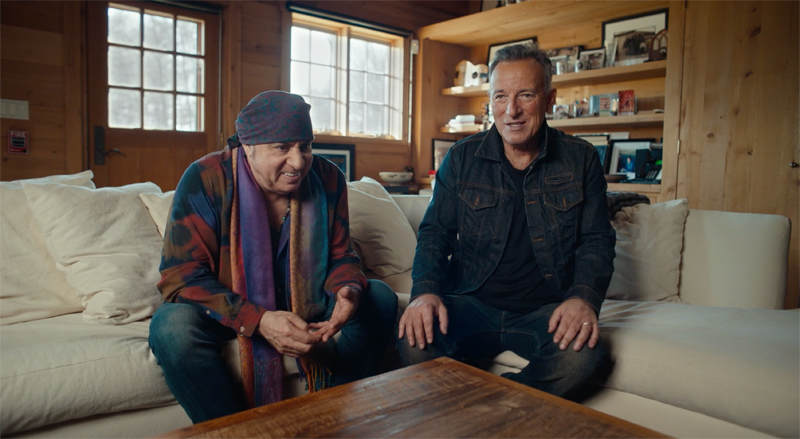
In tackling such an iconic scene, Sumner needed to bring his booking chops on this. Bruce Springsteen, Steven Van Zandt, Patti Smith, Billy Joel, Paul Simon, Art Garfunkel, Jon Bon Jovi, Gene Simmons, and Bette Midler are a few of the big names interviewed. In walk-and-talk backstage moments with Ron, Sumner captures everyone from Jimmy Buffett to Cher, and in archival clips, he renders The Beatles, David Bowie, and Andy Warhol in living color. When dealing with such a star-studded roster, there can be an instinct in documentary filmmakers to throw everything at the viewer. Sumner smartly denies this instinct, bringing in each speaker only when the narrative requires them (again, this is the writing craft of documentaries). The effect of this on the viewer is a steady climbing intrigue: if we’re 45 minutes in, and you’re just now showing me your interview with Paul Simon and Art Garfunkel, then I’m sure as hell going to pay attention. What other tricks might you have up your sleeve? Susan Lacy’s HBO documentary on Ralph Lauren achieves a similar suspense: she waits until the second half of the doc to reveal Jessica Chastain and Woody Allen, inspiring a jolt of piqued interest.

I came home from my double-bill somewhat pessimistic about the future of movies and optimistic about the future of TV. I’m heading to London this winter and in anticipation I’m watching The Crown. The strength of the writing in this show is immediately apparent. The characters all stand for something; they have a thematic cause and effect in the story. Each character has their own motivations, and conflict is brought about when these motivations clash, often precipitated by the outsized pressure brought down upon them by the British monarchy. So many characters in movies today just exist in the story. They don’t have a thematic weight. And if they have flaws or motivations, these are not adequately brought into conflict with the flaws and motivations of other characters. Primetime has this problem and I don’t see a scenario in which great writers flee TV for the theatrical experience (at least with the current industry trends). Perhaps the best we can hope for are more experiences like Ron Delsener Presents in which a writer has thought carefully about the role of conflict in our stories, and further, in our lives.
Disagree with my take? Let me know at mvs2132@columbia.edu
Originally published on Substack.


Comments